Fantastic Time Lapse Work

Posted in Uncategorized with tags , on February 9, 2010 by darwinwiggett

Just check it out! WOW.

The Canadian Landscape Contest – Dan Lewis

Posted in Monthly Photo Contest with tags , , , , , , , , on February 9, 2010 by darwinwiggett

Dan Lewis

©Dan Lewis


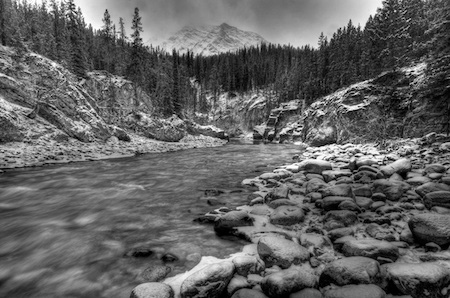
I captured this image while on a Sunday exploration trip with my wife. We were driving through Yoho National Park when we encountered heavy fog. Travelling further the fog broke to unveil this painterly image. The scene looks serene but it was super cold standing on the side of the highway! This is a three shot HDR image. I also used my Singh-Ray Gold-N-Blue Polarizer. Canon 50D 17-85

The Daily Snap – Feb 9

Posted in The Daily Snap with tags , , , , on February 9, 2010 by darwinwiggett

©Darwin Wiggett - Canon G11

This is a close-up of a red onion slice backlit on a light-table. I can’t believe just how good the macro mode is on the G11. I love it! With macro anything in the kitchen is fair game for a Daily Snap! Even if I only have 5 or 10 minutes a day, I can come up with something interesting just shooting in my house  with the Canon G11 in macro mode.

Using Filters on the Canon G11

Posted in Gear, Techniques with tags , , , , , , , , on February 8, 2010 by darwinwiggett

When I owned a Canon G9, I bought the conversion lens adapter that Canon made for the G9. I simply attached my Cokin P-holder to the Canon lens conversion adapter using a Cokin 58mm adapter ring and I was up and running using my Singh-Ray filters on my G9. So when I bought the Canon G11, I also purchased Canon’s Conversion Lens Adapter LA-DC58K (the G9 version would not fit of course – thanks Canon!). I assumed that I could simply attach my Cokin P-holder to the new G11 adapter and be off filtering my photos (see photo below).


Well… guess what? The adapter that Canon makes specifically to attach supplemental lenses and filters on the G11 vignettes at the widest lens setting on the G11–see top image in the photo below! What the hell? Why would Canon make an accessory for a camera that does not work properly? Thanks Canon. And to add insult to injury, once a Cokin P-holder and a Singh-Ray drop-in polarizer is added to the set-up, vignetting gets even worse (see bottom image of the photo below).


A solution to the vignetting problem inherent in Canon’s (poorly designed) conversion lens adapter is to buy a 72 mm filter adapter made by Lensmate. This adapter fits onto the Canon G11 in two parts and allows use of 72 mm filters without vignetting. I tried the Lensmate 72 mm filter adapter without any filters and as promised it did not vignette at all. But when I attached my Cokin P-holder with a 72 mm adapter ring and used a Singh-Ray drop-in polarizer vignetting occurred at the widest focal-length setting on the G11.

According to Lensmate, the only way to get around vignetting issues and still use a Cokin P-holder is to slide the P-holder onto the bayonet mount of the Lensmate 72mm adapter and then use a thin mount screw-in polarizer in the threads of the Lensmate adapter (see photo below). If you use this set-up then you have room for one extra drop-in filter in the Cokin P-holder. When I tried this configuration I did not get any vignetting even at the widest focal length setting on the G11. Finally!

With my Canon G9, I could use three filters in my Cokin P-holder. But with the configuration suggested by Lensmate, I can only use two filters with the Canon G11. This limitation is not too serious considering that the Canon G11 has a built-in ND filter (the third type of filter I would normally add). I can still use a polarizer and a grad together on the G11. The main problem with the Lensmate solution is that I needed to buy a separate 72mm polarizer specifically for my G11 – ouch my pocketbook!

If you do not want to spring for an extra polarizer  for your G11 and you already own a drop-in polarizer for your Cokin P-holder then simply understand that you’ll need to zoom out slightly from the widest setting on the G11 to avoid vignetting with the Lensmate and a Cokin P-holder (the price you pay for saving money). So for those photographers interested in using filters on the Canon G11 (or Canon G10), the Lensmate System will work perfectly but it will hurt your wallet especially if you need to buy a separate 72mm thin-mount polarizer.

The Daily Snap – Feb 8

Posted in The Daily Snap with tags , , , , on February 8, 2010 by darwinwiggett

©Darwin Wiggett - Canon G11

I love the macro mode of the Canon G11. This leaf is about the size of my palm and was strongly backlit. I grabbed the G11, switched to macro mode and within seconds had a wonderful detailed macro. Try that with a dSLR!

The Daily Snap – Feb 7

Posted in The Daily Snap with tags , , , , on February 7, 2010 by darwinwiggett

©Darwin Wiggett - Canon G11

I found this pigeon feather in the snow on one of my walks with Brando. The thing I love about the G11 is how easy it is to make macro and closeup photos handheld. Even if I have my big ‘pro’ camera and a macro lens, I find myself digging out the G11 instead because macros are just so fun with this camera. With my Mark III, macros are work!

The Daily Snap – Feb 6

Posted in The Daily Snap with tags , , , , on February 6, 2010 by darwinwiggett

©Darwin Wiggett - Canon G11

I walk by this sign almost everyday when I am home. I have photographed the sign a couple of times but I liked the way the clouds framed the sign yesterday and so snapped a shot. The benefit of having a dog to walk is that I get out at least three times a day.

Warning! Things You Need to Know About Photo Tours

Posted in Controversy, Ethics, Workshops with tags , , , , , on February 5, 2010 by darwinwiggett

This post is  for those photographers who plan on leading their own photo tours.

(And for those planning to participate in a tour.)

Making money in nature photography is a difficult proposition. The competition is fierce and the prices paid for photos is low. There is a glut of great images out there yet there are very few photo buyers. One way that many hungry photographers (myself included) supplement their income is to organize and lead photo tours. Not only are tours fun, but they get you out shooting with like-minded people. It seems everyone has jumped on the Photo Tour bandwagon, from high-profile shooters who never used to lead tours, to the local guy who just picked up a camera a year ago.  It makes sense:  what could be easier than taking a bunch of people out to your favorite locations and showing them how you do things… and get paid to do it?

What You Don’t Know Can Hurt You

Liability Issues

I’m no lawyer, and my comments here do not count of course as legal advice. But I would like to highlight some things to consider before you lead or take a photo tour.  First, once you take other people out in the capacity of a paid business venture, the issue of liability comes up. Do you have liability insurance for when you accidentally smack someone in the face with your tripod? What if someone falls off a cliff or slips on ice and breaks a leg? Nature is dangerous; do you have insurance to cover the eventuality of an injury? And do you have basic first aid training and a first aid kit with you at all times?

Another issue to think about are waivers.  Do you have a liability waiver form made up by a qualified lawyer? Do you get people to sign this form before your event? A document that you crafted at home may not cover you. You may need to pay a qualified person to help you craft a proper document.

Speaking of liability, if you carry paid participants in your vehicle and get in an accident, your insurance company will likely not cover you because personal insurance does not cover commercial activity. So if you want to taxi around participants, you’ll need commercial insurance on your vehicle. Things are starting to sound expensive eh? Still wanna do tours?

Permits

Most photographers lead tours to publicly owned land in the form of National, State, or Provincial Parks. These parks often require that you have a permit for any commercial enterprise. You can’t just take a group of people into a national park, have them pay you for the service without the need of a permit and payment to the parks administration of a fee of some sort. So do your homework and get the proper permits. Most parks will not give you a permit unless you can prove you have liability insurance.

Permissions

If you want to shoot on private property you’ll need written permission or a consent form from the property owner. Do not take participants onto private property without landowner permission or your liability insurance will be voided. If you are taking participants to photograph old barns, or a funky old church and you want to be able to sell the photos from the shoot, then you will also need a property release form signed by the legal owner of the building. And if you photograph people on a photo tour, you better get permission first and even better get a model release for everyone you photograph. It is better to hire models specifically for your photo tour so you can get releases for payment. Also does your liability insurance cover paid talent?

Work Visas

If you are planning a photo tour to an exotic local, do you have all the proper documentation in place to do commercial activities in that country? Do you need a work visa? Do you have all permits and insurance to cover you? Foreign tours are especially tricky — you do not want to be booted out of the country in the middle of a tour simply because you neglected to properly set things up. I know of numerous foreign photographers who lead tours in the Canadian Rockies that do not have permits, work visas or insurance. They are a disaster waiting to happen.

Expectations

You have to deliver something to participants beyond what they would get if they came on their own to a location. For instance, I get people to places they would not find on their own and I get people to the right places in the right light and offer help with instruction in the field as necessary. Other instructors offer formalized instruction. What are you offering? If this is just a way to get paid to shoot, then look for other avenues of revenue.

For those looking at joining a photo tour, ask important questions. Do you really want to go with someone who has shady business practices or is simply ignorant of the requirements needed for successful tours? If photo tour leaders cannot provide you with information about insurance, permits, permissions, releases and waivers, then steer clear!

©Darwin Wiggett - Rockies Spring Photo Tour

Weekly Photo – Feb 5

Posted in Gear, Techniques, Weekly Photo with tags , , , , , , , , on February 5, 2010 by darwinwiggett

©DArwin Wiggett - Canon EOS-1ds Mark III, 24mm TS-E lens

When I first saw this rock with a leaf on it, I snapped a few photos with my Canon G11. I posted a B+W as a Daily Snap for Jan 28. After I saw the potential in the scene, I grabbed my ‘big’ camera and played around. In this photo I used two filters; the Singh-Ray Gold-n-Blue polarizer to add colour to the scene, and a Singh-Ray 5-stop solid ND filter to lengthen the shutter speed so I could get blurred water. To see what the scene looked like with out filter, I shot a comparison image below. Notice in the non-filtered image the bird poop on the rock; in the final image above, I cloned out the turd.

©Darwin Wiggett - no filters

The Daily Snap – Feb 5

Posted in The Daily Snap with tags , , , , , , , on February 5, 2010 by darwinwiggett

©Darwin Wiggett - Canon G9

This image was taken in October with my Canon G9 and a Singh-Ray Gold-n-Blue filter. I like the way the filter added a gun-metal blue to the water to contrast with the yellow Aspen leaf.